Pannon-Coccia bowl
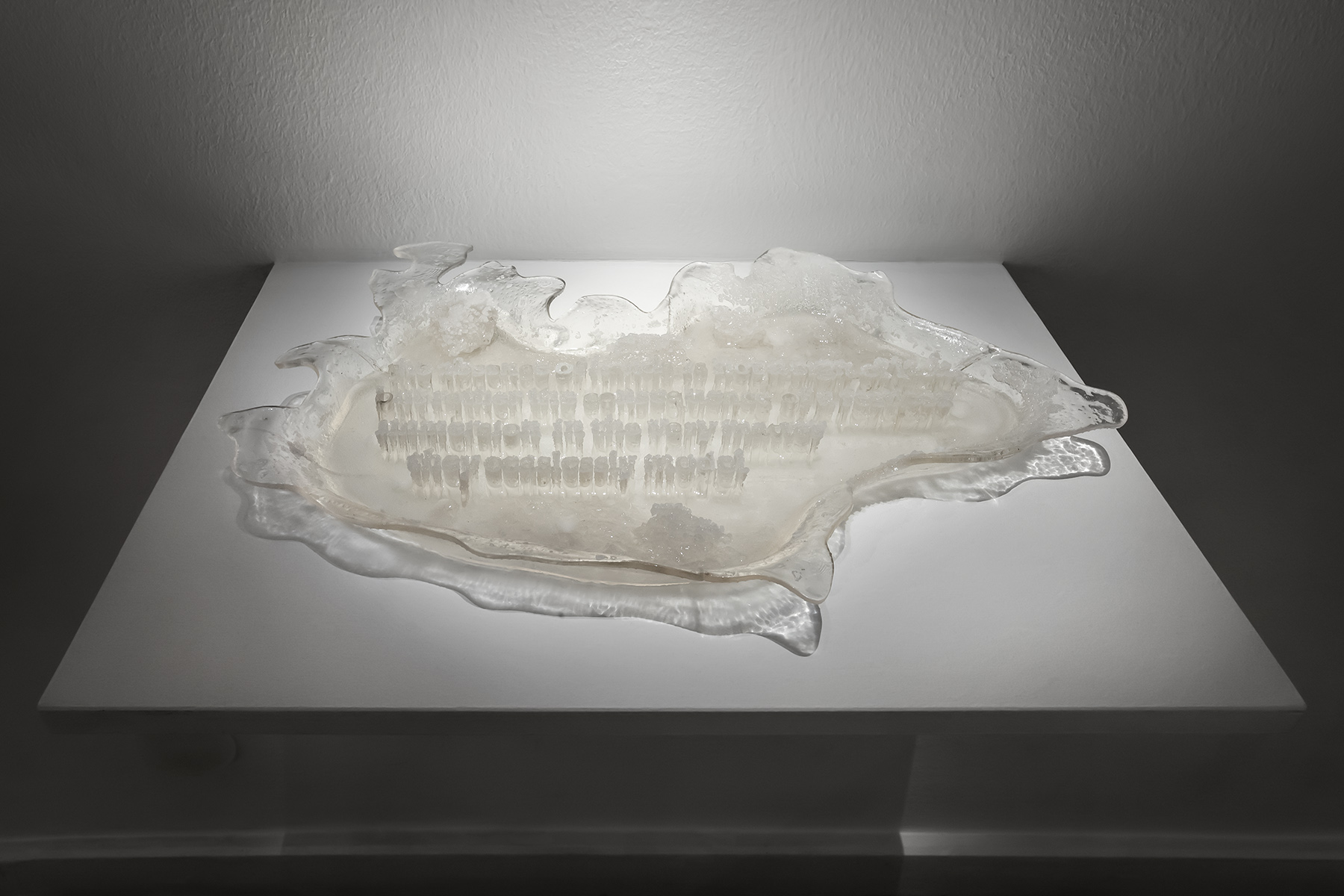
The work is a bowl shaped after the contours of the Pannonian Sea, inscribed with a quotation from Emanuele Coccia’s The Life of Plants: A Metaphysics of Nature: “the absence of hands is not a sign of lack but rather the consequence of the restless immersion in the very matter they ceaselessly model.” The book, dedicated to the philosophy of plants, describes how vegetal life produces the very environment in which it exists, realizing a state of total permeability in which body and world are inseparable.
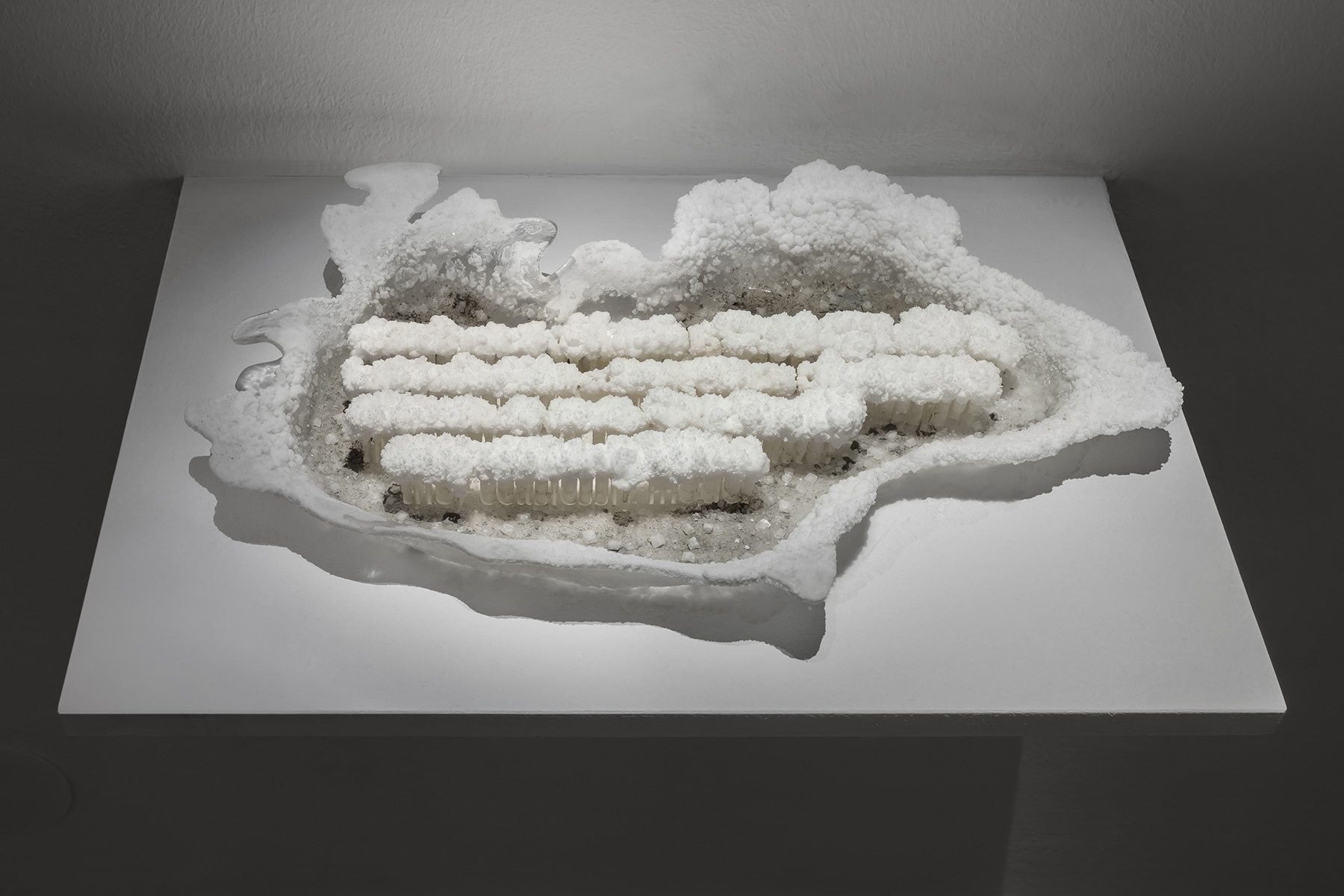
Inside the bowl, Parajd rock salt and water form a saline solution that slowly crystallizes. Over the course of several days, the growing salt gradually obscures the inscribed text until it disappears entirely beneath the crystalline surface. The work thus stages a process in which meaning is not preserved but metabolized by material itself.
This slow erasure resonates with Timothy Morton’s concept of dark ecology, in which nature is no longer an idealized, transparent system but an entangled, unsettling field where beauty, loss, and damage coexist. The bowl does not present nature as a stable ground or a harmonious backdrop, but as a process that absorbs, overwrites, and exceeds human language and intention.
The work has acquired an additional and unintended layer of meaning in light of the flooding that occurred in Parajd at the end of May 2025, when salt—normally a marker of preservation—became vulnerable to dissolution and loss. In this context, the crystallizing and erasing text becomes a quiet memorial to ecological instability, reminding us that material processes operate beyond symbolic control, and that immersion in matter is never without consequence.