Category: Uncategorized
Marsyas’s skin
Honey Bones
itt is lesz leírás
Cave hand
Rosetta drip
Salt ridge: on the border of two worlds
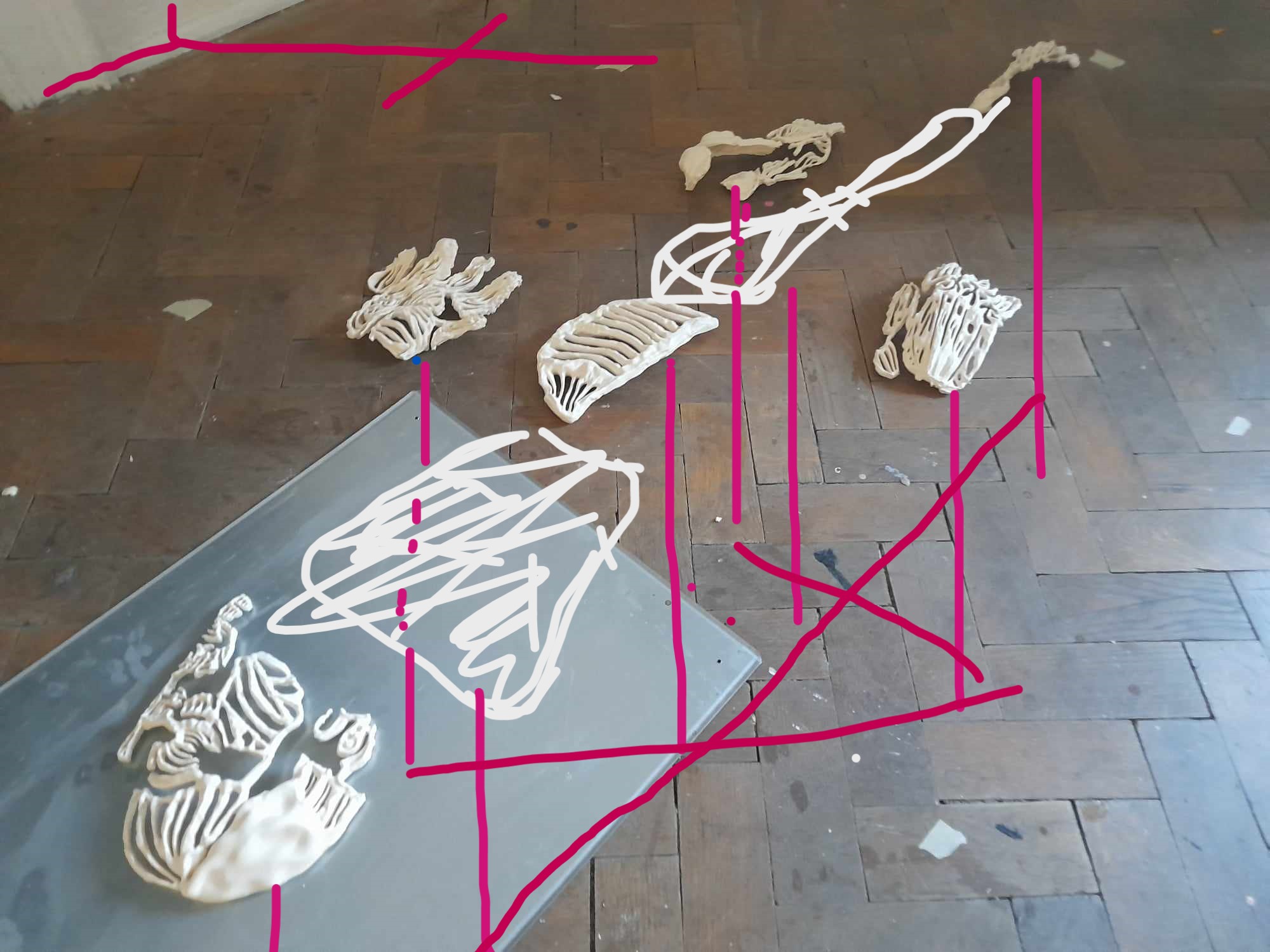
Although Nóra Szabó’s critical art practice, which is shaped by the principles of posthumanist discourse and aesthetic, is primarily oriented towards the crisis and change in the representation of the human body image and, at the same time, the reconfiguration of the scattered remains of the human figure, her diverse combinations of materials and media, as well as her hybridization techniques, also open up space for visions of speculative or even nonhuman entities and realities. In this latter context, on can discuss the unusual configurations and the crystalline structures applied to them, which represent the mosaic-like soil patterns of the high-salinity soils of the Hungarian steppe (puszta) and the shapes of a specific indigenous plant species of the Great Hungarian Plain (Alföld), the Hungarian saltwort (Limonium gmelinii). The sculptural, island-like forms in the space are negative forms of cracks in the salt ridge recreated from resin. These translucent imprints, and the voids revealed between and through them, suggest the semming barrenness of the steppe (puszta), the long summer droughts, the high salt content of the soil, and the low rainfall. This apparent lifelessness is contrasted, however, by the similarly translucent flowers, covered with salt crystals, which, in the case of the group of objects, are given body by the very material that represents their daily struggle in the living world. To this extent, the crack marks, and the branch-like stems and flower clusters that are attached to them, not only evoke the extreme enviromental conditions of the specific lowland but also point to the adaptive and resistant modes of operation that ensure the survival of vegetation with an optimally slowed metabolism, suggesting a shift towards a temporality that may extend beyond the human scale.
— text by Edward Kovács, assistant curator at Modem
This project was realized within the framework of the Learning from Nature? Botany exhibition at MODEM.
Human Pattern Project
Guided by posthuman theories, the Human Pattern Project explores the possibilities of the human, the post-human, and the world without humans. It examines the nature of human communication and visual expression as imagined from the perspective of a world without or beyond humans. This approach is driven by the conviction that thinking through the non-human brings us closer to understanding the concept of the human itself.
Global changes that have become increasingly prominent in recent years are fundamentally transforming concepts of the human. The relationship between humans and their environment is being redefined, as is our relation to emerging technologies. Through past and ongoing developments in contemporary science and technology, the possibility of the human–machine hybrid has become a tangible reality. Posthuman theory describes a radical transformation of human identity. The central question of the project is how these shifts alter our understanding of the human body.
The project assumes that the natural body, on the one hand, is elevated to a new level through artificial materials—such as implants, artificial intelligence methodologies, and robotic systems—and, on the other hand, that these developments fundamentally transform the very concept of the body. The contemporary notion of the human reveals a heterogeneous composition that can be represented in the visual arts through the combined use of analogue and digital media. Consequently, the installation is based on intermedial foundations, integrating sculptural and digital techniques. Digital constructions form the basis of the artworks, which subsequently materialize as casts.
At the core of the project lies a digital structural blueprint of the human body surface, depicting the skin in a segmented form. In Hungarian, this is referred to as a “szabásminta”, or sewing pattern in English—simplified in the title to Pattern. This pattern functions as the foundational framework for the entire project: every sculpture, installation, and artwork emerges from it. On the one hand, it can be interpreted as a tutorial for the creation of an alternative yet human-like form of existence, symbolizing the possibility of continuation and the survival of human existence under altered conditions. On the other hand, it presents a dystopian vision of a world without humans, in which the human pattern functions as a time capsule, preserving the human type as an expired, relic-like memory of the past.
The Human Pattern Project was developed between 2018 and 2024, and the central pattern was explored through numerous sub-projects, including Grauballe George and Janus Coin. Across these different contexts, the pattern was elaborated in multiple forms, allowing its meaning to be nuanced and layered; yet the central concept described above remained at the core throughout the project.
Grauballe George
Amikor terveztem az utamat 2023 nyarán Kassára, ahová egy három hónapos művészeti rezidencia programon való részvétel miatt utaztam, elhatároztam, hogy meglátogatom a Baradla barlangot, amire még egy gyerekkoromban tett kirándulásról emlékeztem. A Baradla barlang egy barlangrendszer része, ami átível Szlovákia és Magyarország határain: magyar részről Baradla, szlovák részről Domica barlangokkal. A barlangok egy rendszer részét képezik, elvileg átjárhatóak, de ez csak szakértő barlangjáró számára lehetséges, a barlang e részeinek nehéz megközelítése miatt. A Baradla barlang meglátogatására, mint egy földalatt megbúvó, titkos átjáróra tekintettem, ami összeköti a két országot.
A barlang kialakulása a triász időszakban kezdődött, amikor még ezt a területet tenger borította. Az itt élő, majd elpusztult állatok maradványiból meszes üledék rakódott le, később a tenger visszahúzódott, a meszes üledék megszilárdult, a terület pedig kiemelkedett és így a föld rétegeiben többféle mészkőformáció alakult ki. A kőzetekben jelenleg is megfigyelhetőek ősmaradványok, például zöldalgák, tengeri liliomok maradványai. A barlangrendszer teljes feltárt hossza meghaladja a 30 kilométert. Látogatóként a barlang bejárása során úgynevezett termeken haladunk át. A termek neve az ott látható cseppkövek formáiból ered: Anyósnyelv, a Mikulás, a Tigris, az Oszlopok csarnoka, hogy csak néhányat említsünk.
Sokféle elmélet létezik arról, hogy az ember hogyan azonosítja a tárgyakat a környezetében. Az egyik ezek közül a minta felismerés elmélete, miszerint minden egyes érzékelt tárgy a környezetünkben sablonként raktározódik el a hosszú-távú memóriában. Tehát a megfigyelés során az adott tárgy képe először a rövid-távú memóriába kerül, majd aktivál egy területet a hosszú-távú memóriában, így az onnan előhívott sablon segítségével felismerjük az adott tárgyat. Erre egy egyszerű példa a betűk olvasásának folyamata: egy különbözőféleképpen leírt A betűt mindig A betűnek érzékelünk, hiába torzítva jelenik meg előttünk. Természetesen ennek a torzításnak, hogy a forma előhívható legyen, megvannak a határai, egy adott ponton túl már nem tudjuk sablonhoz kötni. Ami engem ebben kifejezetten érdekel, az az a határvonal, amikor felismerhető valamilyen sablon a látvány alapján, de még nem tudjuk pontosan mire emlékeztet minket. A barlang formái határozottan megidéznek egy általunk jól ismert formát, de mégis azon a határon, amikor még nem tudjuk pontosan beazonosítani, mire is emlékeztetnek minket. Ez a meghatározhatatlanság és bizonyosság érzésének keveredése, amit előhívnak a barlang formái.