Human Pattern Project
Guided by posthuman theories, the Human Pattern Project explores the possibilities of the human, the post-human, and the world without humans. It examines the nature of human communication and visual expression as imagined from the perspective of a world without or beyond humans. This approach is driven by the conviction that thinking through the non-human brings us closer to understanding the concept of the human itself.
Global changes that have become increasingly prominent in recent years are fundamentally transforming concepts of the human. The relationship between humans and their environment is being redefined, as is our relation to emerging technologies. Through past and ongoing developments in contemporary science and technology, the possibility of the human–machine hybrid has become a tangible reality. Posthuman theory describes a radical transformation of human identity. The central question of the project is how these shifts alter our understanding of the human body.
The project assumes that the natural body, on the one hand, is elevated to a new level through artificial materials—such as implants, artificial intelligence methodologies, and robotic systems—and, on the other hand, that these developments fundamentally transform the very concept of the body. The contemporary notion of the human reveals a heterogeneous composition that can be represented in the visual arts through the combined use of analogue and digital media. Consequently, the installation is based on intermedial foundations, integrating sculptural and digital techniques. Digital constructions form the basis of the artworks, which subsequently materialize as casts.
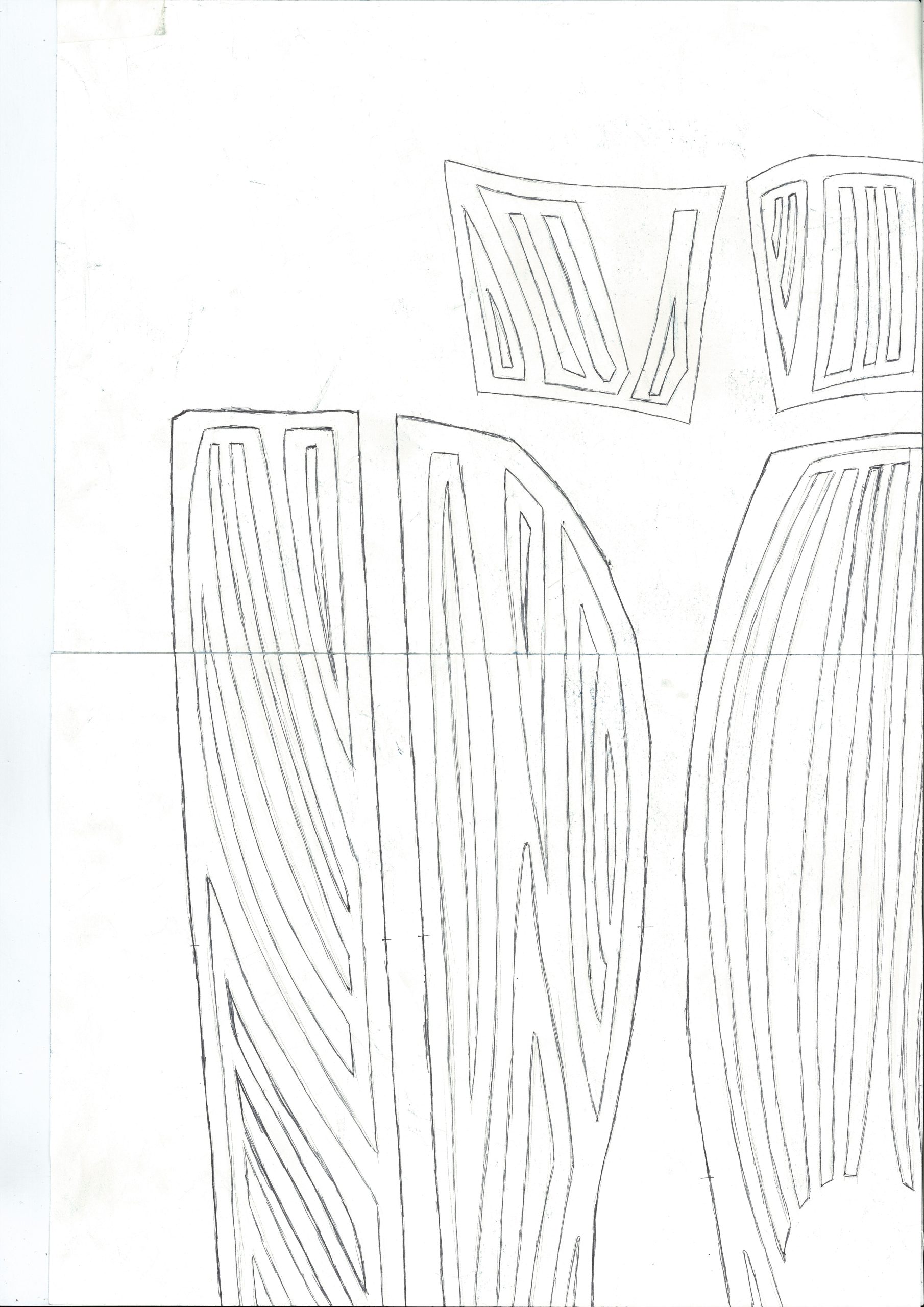
At the core of the project lies a digital structural blueprint of the human body surface, depicting the skin in a segmented form. In Hungarian, this is referred to as a “szabásminta”, or sewing pattern in English—simplified in the title to Pattern. This pattern functions as the foundational framework for the entire project: every sculpture, installation, and artwork emerges from it. On the one hand, it can be interpreted as a tutorial for the creation of an alternative yet human-like form of existence, symbolizing the possibility of continuation and the survival of human existence under altered conditions. On the other hand, it presents a dystopian vision of a world without humans, in which the human pattern functions as a time capsule, preserving the human type as an expired, relic-like memory of the past.
The Human Pattern Project was developed between 2018 and 2024, and the central pattern was explored through numerous sub-projects, including Grauballe George and Janus Coin. Across these different contexts, the pattern was elaborated in multiple forms, allowing its meaning to be nuanced and layered; yet the central concept described above remained at the core throughout the project.